Showing posts with label social media. Show all posts

Friday, January 31, 2020

Commerce and philosophy


"I do nothing but go about persuading you all, old and young alike, not to take thought for your persons or your properties, but and chiefly to care about the greatest improvement of the soul. I tell you that virtue is not given by money, but that from virtue comes money and every other good of man, public as well as private. This is my teaching, and if this is the doctrine which corrupts the youth, I am a mischievous person." -Apology
An excerpt from Ezra Klein's new book, Why We're Polarized, explains how social media (which are commercial ventures) contribute to political polarization.  They cater to people's sense of their identity.  A flavor of Klein's excerpt (which is worth reading in its whole):

To post that article on Facebook is to make a statement about who you are, who your group is, and, just as important, who is excluded.
In political media, identity is affirmed and activated with slightly more oblique headlines. But the underlying dynamic is the same: This public figure that you and everyone in your group loathe said something awful. This poll came out saying you and your group are going to win or, better yet, that your out-group is going to lose. This slashing column explains why you’re right about everything and why your opponents are wrong.
[...]
When I entered journalism, the term of art for pieces infused with perspective was “opinion journalism.” The point of the work was to convey an opinion. Nowadays, I think a lot of it is closer to “identity journalism” — the effect of the work, given the social channels through which it’s consumed, is to reinforce an identity.
But an identity, once adopted, is harder to change than an opinion. An identity that binds you into a community you care about is costly and painful to abandon, and the mind will go to great lengths to avoid abandoning it. So the more media people see that encourages them to think of themselves as part of a group, and the more they publicly proclaim — through sharing and liking and following and subscribing — that they are part of a group, the deeper that identity roots and the more resistant the underlying views become to change.
The bad online social dynamics that result from this are all well-known and widely loathed by now, but it got this way because it was profitable for the social-media companies to form their algorithms in this direction.  It is, in other words, what the market demands, and they're meeting that demand.

In an intellectually bankrupt culture, the natural result is the highly-polarized toxicity.  (For reasons I've given time and time again, a very large share of the blame for this goes to what I now term a structural dishonesty in the intellectual culture of leftism; the only question for me is whether this structural dishonesty is subtle, or whether it is blatantly obvious.)  (Other examples of structural dishonesty would be authoritarian regimes, such as those in China and Iran, that censor and punish dissenting voices.  No question in these cases how blatantly obvious the dishonesty is.)

The point I'll jump right to: Commerce is neither good nor bad, per se.  It is how well-ordered the commerce is, vis-a-vis the needs and care of the soul.  I'm not really saying anything new here, but I think social media toxicity and polarization are explained by the principle involved.  Social media algorithms are directed toward user pleasure or utility, but the dollar - the bottom line - does not discriminate between the higher and lower pleasures.  A pleasure that is triggered by having one's prejudices reaffirmed is a lower - base and ignoble - pleasure.  A pleasure related to the perfection of one's intellectual capacity is a higher pleasure.

For example: if you spend all of your cable news viewing time only on Fox News, or only on CNN, you get your political-identitarian preferences satisfied, and the companies'/advertisers' bottom lines get served, but the effects are blatantly toxic.  (I regard MSDNC as a lower level (akin to the sewer if the other two are the gutter) of 'news and opinion' presentation entirely - pleasurable to the toxic/twitterized/AOC left, and repulsive to just about anyone else.)  If, on the other hand, your interest is in dialectic - of obtaining the widest story or context or breadth of opinion or input - then you'll divide your time between these sources as well as plenty of other diversified non-cable-news sources.

J.S. Mill not only famously distinguished between the higher and lower pleasures - captured in his famous phrase "Better to be a Socrates dissatisfied than a fool satisfied" - but (and this is part of the wider context with which this higher/lower distinction has to be dialectically integrated) he also said of opinion polarization:

He who knows only his own side of the case knows little of that. His reasons may be good, and no one may have been able to refute them. But if he is equally unable to refute the reasons on the opposite side, if he does not so much as know what they are, he has no ground for preferring either opinion... Nor is it enough that he should hear the opinions of adversaries from his own teachers, presented as they state them, and accompanied by what they offer as refutations. He must be able to hear them from persons who actually believe them...he must know them in their most plausible and persuasive form. (On Liberty)
Not only is this essentially a formulation of the Dennett/Rapoport Rules a century-plus in advance, it's also a principle I hope over time, with thorough-enough research, to be able to exemplify in my own philosophic practice.  Tying these points together with a figure much-smeared in blatant defiance of Mill/Dennett/Rapoport, Ayn Rand, let's have a look at what Rand has to say about money (a point where she seems to be especially smeared by her enemies if not sometimes or often merely innocently misunderstood by others):
So you think that money is the root of all evil? . . . Have you ever asked what is the root of money? Money is a tool of exchange, which can’t exist unless there are goods produced and men able to produce them. Money is the material shape of the principle that men who wish to deal with one another must deal by trade and give value for value. Money is not the tool of the moochers, who claim your product by tears, or of the looters, who take it from you by force. Money is made possible only by the men who produce. Is this what you consider evil? [...] 
Have you ever looked for the root of production? Take a look at an electric generator and dare tell yourself that it was created by the muscular effort of unthinking brutes. Try to grow a seed of wheat without the knowledge left to you by men who had to discover it for the first time. Try to obtain your food by means of nothing but physical motions—and you’ll learn that man’s mind is the root of all the goods produced and of all the wealth that has ever existed on earth.
A strawman version of Rand - e.g., this one in "the world's most popular philosophy [sic] blog" - would excise Rand's praise for money-making from the philosophic context in which it is embedded.  The context is indicated in part by the "see also" cross-references in the "money" link I've provided and quoted from, and is contained in full in the whole of the Lexicon - the virtue of rationality most fundamentally, and the virtue of productiveness more proximately.  I once encountered an online Rand-basher who quoted from the "money speech" (excerpted above) the following one line: "The words 'to make money' hold the essence of human morality."  (To treat this quotation in isolation from the wider context of Rand's work is par for the course for Rand-bashers.)  The strawman version hyperlinked above (also par for that loathsome course, and which also implicitly if not explicitly recklessly smears the Ayn Rand Society scholars (e.g.) as "imbeciles") characterizes Rand's ethics as being a money-grubbing one in stark contrast to Nietzsche's evident disdain for market values.  But Rand's philosophy was consistent between Atlas Shrugged (where one finds the "money speech") and her earlier novel The Fountainhead.  John Galt and Howard Roark are each in their own way Rand's concretized-in-art ideal men.  And as is well-known to readers of The Fountainhead, Roark was committed so much to his own creative vision that he turned down a major commission, resulting (for the time being) in his firm shutting its doors.  The wealthiest character in the novel, Gail Wynand, is a foil to the heroic Roark, a man ultimately destroyed by having pandered to the mob/his "livelihood."

Put another way: Roark (and by implication her other heroic figures) regarded money-making as virtuous as long as it was virtuous, i.e., expressed the higher nature and possibilities of humans, including creative independence and integrity.  Rand's commitment to such noble ideals, as against the base, is made explicit in her discussion of that "noble soul" passage from Nietzsche (Beyond Good and Evil Aphorism 287) with which she originally planned to introduce The Fountainhead and then reintroduced/discussed in its 25th anniversary edition.  The Randian hero is a lover of self in the Aristotelian sense (for Aristotle, the "noble soul" is the great-souled or magnanimous man), a connection that a leading Nietzsche translator and interpreter, Walter Kaufmann, drew in his editor's footnote to Aphorism 287.

Which is to say, to neatly tie the various themes of this post together, that to combat social media toxicity in particular and commercial crassness in general, the market participants could do considerably better to aspire to the ideals espoused by Aristotle, Nietzsche and Rand - and to aspire to greater virtue/nobility/wisdom/understanding/dialectic/etc. generally (as with Socrates, Mill, Rapoport and Dennett).

Friday, July 5, 2019

Is AOC a head case?

I've already written about how AOC (a.k.a.: Another Obnoxious Commie) is a recklessly ignorant and toxic moral-blowhard.  But based on the latest info I've seen, I am led to ask: is she also a head case?

Witnesses say that AOC screamed at border patrol agents on her visit to a detention center (where she implausibly claimed that agents told detainees to drink from the toilet - a claim that should be looked into as a litmus test of AOC's credibility on basic facts, much less her warped worldview).  But this particular item caught my attention:
A second official said that while she was around agents, Ocasio-Cortez commented at another point about an unofficial Border Patrol Facebook page that was exposed earlier Monday for offensive content about those in custody and lawmakers, including the congresswoman.
“Something under her breath, ‘Oh, all these guys in here are gonna f--k me.’ ..."
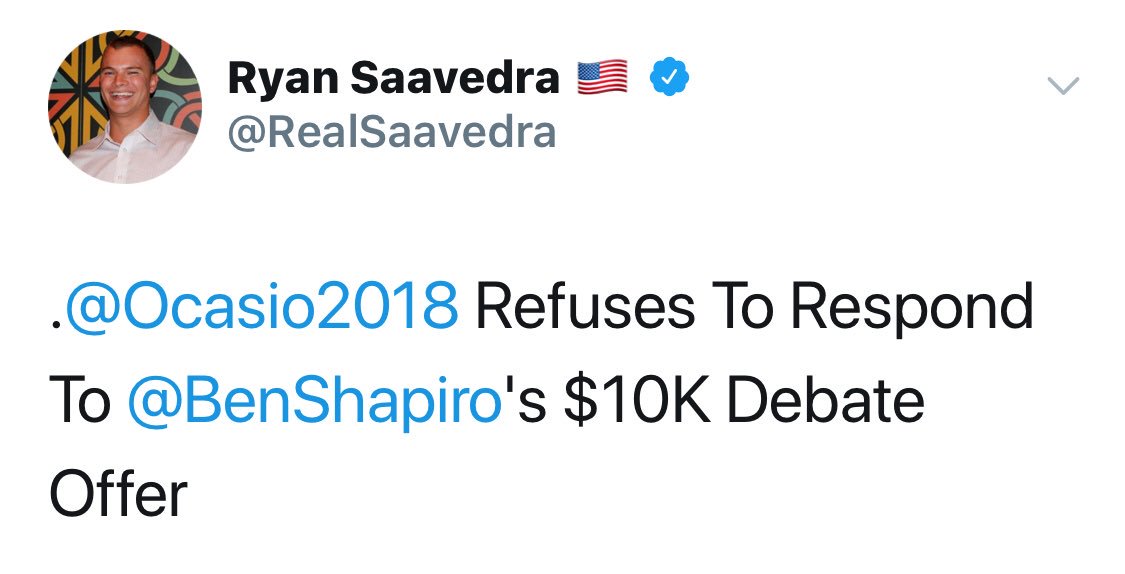
Now, any epistemically competent thinker knows to discount eyewitness testimony without independent evidence supporting either the claim or the witness's credibility.  Well, in this case there is a piece of independent evidence.  Last year, Ben Shapiro on twitter challenged the Commie to a debate, and this was her reply:


Just like catcalling, I don’t owe a response to unsolicited requests from men with bad intentions. And also like catcalling, for some reason they feel entitled to one.

(If one has any doubts as to the kind of intellectual lowlife who constitute the Commie's army of defenders on the meme-cesspool that is twitter, just have a look at the thread that ensued.)

Now, how is the Commie supposed to know whether Shapiro's intentions are bad?  She doesn't explain how they are bad.  (The simplest and best explanation is: she can't.)  And what is a sane observer to make of her characterizing the debate challenge as a catcall?  (And what's with her mangled diction?  "Like catcalling, I don't owe ...")

Isn't it telling about her state of mind that the first words out of her twitter account in response to a debate challenge is "catcall"?  (Note what's telling about her state of mind when she pulls the "diversity" card the split second she sees CBS's announced election-coverage lineup.)

And what's with the distinctively leftist weaponizing of sexual political correctness (sic) these days (much less the patently dishonest weaponizing of #MeToo to smear Kavanaugh)?  (Or: the patently anti-fair-process malice of university administrators and their kangaroo courts?)  The only thing it helps to show is what a bunch of discreditable lowlife and dialogue-avoiders they are.  The Commie and other leftist scum think this sort of thing is an appropriate and normal MO; the fake-news CNN/NYT crowd and the leftist lowlife on twitter enable it.  The "but Trump/Republicans" whataboutism doesn't remedy any of that.

What if the Commie is little more than an unvetted, charismatic head-case?  Is she a false flag, a satirical figure?  How would we tell either way?

[Addendum: Newt calls out AOC as a dishonest POS.  Is her reply to Newt an honest one?  No, it is not, and you'd have to be a willfully blind or self-enstupidated partisan POS not to see that it isn't.]

Wednesday, June 26, 2019

When AOC wept, or: she retweeted the photos

[Point of reference: "When Chomsky wept"]

Another Obnoxious Commie (AOC) retweeted photos of herself weeping at the sight of detained children at the border.  Maybe this insufferable ignoramus just doesn't have enough life experience to know this is in poor taste (presumably someone like Chomsky would know better) - which then gives lie to her pretense to being a know-it-all with the intellectual and moral chops to take down all those right-wing jerks in a single tweet.

Her photo-retweeting amounts to a phony display of moral superiority.  I don't mean that her tears are phony - I'm sure that anyone with moral common sense could weep at the tragically shitty situation these kids detained at the border are in - but that her pretense to moral superiority is.  AOC (and the left's) intellectual and moral compasses aren't superior to the rest of ours.

And since AOC is always on the pretend-moral-superiority march - and she's made clear that factual correctness and knowledge take a back seat to moral correctness (how's that for a fact/value dichotomy, eh? or: how does she know she's morally correct?  or: if she's so factually ignorant and all full of hubris on that count, how morally upstanding is that?  or: if she's so unreliable factually and full of hubris on that count, how reliable is she on moral questions?) - this photo-retweeting thing would be just another instance in a long sequence of phony moral grandstanding.

She's getting eaten alive on twitter for this, which is all too fitting given her charismatic exploitation of that notoriously toxic, anti-intellectual, dopamine-over-truth medium.

Doing a bit of searching on this I came across a couple paragraphs from an opinion piece by David Limbaugh every bit of which rings true:
But here's the good news. AOC is unteachable, because she is unwilling to be taught. Full of hubris, she already knows everything and is the champion of every leftist cause. She leads with her unbridled emotions, happily ignorant of the facts. House Majority Leader Nancy Pelosi would love to corral her but would not dare even hint at that, shrewdly recognizing the mob attraction AOC enjoys with the Party's shrieking base. Pelosi knows better than to chastise AOC and so ducked the question when asked why AOC never shuts up. 
Well, I'm with Pelosi, for different reasons. Please don't shut up, AOC. We appreciate your drawing a sharp contrast every day between the noxious views of your party, which now dutifully embodies your extremism, and those representing responsible governance. Thank you for liberally exercising your First Amendment freedoms.
The issue here isn't AOC per se - the only reason she's a national figure is that she's a charismatic figure (either a good or a bad thing, depending on the context) who won in a thoroughly uncompetitive, ethnically-gerrymandered district where the "exchange of ideas" is limited to doctrinal disputes among extreme leftists (e.g., exactly how much of the talents/energies/minds-bodies of the rich[*] should be at the disposal of the collective/state) - but rather the issue is what her prominence on the national stage says about her party, its hubris and ideological bankruptcy, and the nation's intellectual bankruptcy.   (Cure: philosophical education, for fuck's sake already.)

[* - Speaking of Comrade de Bozio's "money in the wrong hands" remark, I'm left guessing whether he and fellow leftists envision some $100B pile of cash Bezos has stowed away in a vault, not doing anything for anyone.  Maybe they envision him as Scrooge McDuck, diving into and swimming around in a pool of gold coins?  And speaking of Comrade de Bozio, how on earth did New Yorkers elect this clown?  I thought the intellectual and moral compasses were superior there in the big cities?]

Sooner or later she's going to be asked about Ayn Rand and the answer will not reflect well on her, guaranteed - because all she's ever "learned" about Rand is leftist smears she would have lapped up uncritically from within her Comprachico-ized intellectual milieu.  Under not-far-fetched conditions she could easily have been brainwashed into staunch support for a Commie regime; her intellectually reckless antipathy to capitalism virtually assures it.  If you think Rand's portrayal of the public-sector types in Atlas is some kind of wild cartoonish hyperbole - a bunch of obnoxious commies in essence - you only need imagine what a critical mass of AOC- (or Scumbag Duggan-)types run amok would bring about.  Or, heck, just look at the pitiful intellectual and moral state of the Democrat Party today.

There was a time when the Democrats had intellectually and morally decent figures like Sen. Moynihan; there is no comparable figure in the party today (else we'd all know about it, wouldn't we).  The left as a whole still has intellectuals like Chomsky around, but not for much longer.  Hasn't it ever occurred to these hubristic fools that the very best minds - the very tail end of the political-ideological bell curve, not the merely-clever who might be mistaken for being on that tail end - have migrated over time (probably through attrition, given the sorry intellectual character of committed leftists post-Nozick) to the "right," in particular the libertarian (and especially Aristotelian-Randian) variety of "rightist" thought?  If leftists are so sure of their superiority, shouldn't they be willing to put such a hypothesis to the test?

In sum (and it's a point her twitter hecklers in this age of intellectually-degenerate politics struggle to articulate): the very fact of AOC cluelessly retweeting her weeping-photos undermines her pretense to superiority.

Wednesday, February 13, 2019

Toxic social media vs. philosophy, Exhibit A

In addition to following a couple philosophy blogs regularly, I also follow the /r/badphilosophy subreddit (reddit lingo for forum), mainly for the humor value.  I'll get to the badphilosophy subreddit in a moment, but in the last few days there was a link there discussing a link on the /r/philosophy subreddit which discusses and in turn links to a blog post on the meaning of the term "selfishness," mainly in connection with Ayn Rand's usage of the term.

On reddit, the default settings sort comments by "top," as in most net upvotes, and do not display comments that receive 5 or more net downvotes.  The process of upvoting or downvoting is anonymous (and therefore unaccountable) and effortless.  (Surely you can see where I'm going with this?)  So in theory, someone can put in a lot of thought and effort into writing up a comment only to have it "buried" by downvotes, or conversely, someone can make a lazy comment that is popular with the anonymous upvoters and thereby see it elevated to the top of the displayed comments section.

In the instance covered here, the user linking his own blog post, Sword_of_Apollo (an Objectivist), received for his efforts many downvoted comments.

(Digression: It's not exactly germane to the topic of this posting to get into Rand's unconventional but not necessarily incorrect usage of the terms "selfishness" and "altruism" here; the main point is to contrast social media formats with actual philosophical ones uncorrupted by social media toxicity.  But here's my take: Rand's book The Virtue of Selfishness is subtitled A New Concept of Egoism, so what she's proposing is a reconceptualizing of how egoism or self-interest is treated in ethical philosophy.  Usually theorists dismiss egoism on the grounds that it supposedly fails to offer commonsense ethical advice or gives the wrong reasons for doing what morality demands.  Rand, meanwhile, holds that the purpose of morality or ethics is the achievement of happiness; further, happiness is the reward of virtue, the primary virtue being rationality, rationality being the specific mode by which human beings function and flourish.  (I spell this theme out in this blog post.)  To try to make a long story short for purposes of this post, Rand is advancing the case that the agent or author of moral action is properly the beneficiary of that action, specifically in terms of that agent's hierarchy of values.  Rand defines "value" as "that which one acts to gain and/or keep"; values or those things that are important, what one cares about.  At the same time Rand holds that there is a rational standard of value that guides one toward successful or better or happier living, and that for man, that standard is defined in terms of the specific human capacity for reason, which means that the good life for man is rational or thoughtful or intelligent living.  This means exercising one's best judgment about one's hierarchy of values, including one's relations with others.  But to exercise one's best judgment requires one act on one's own independent judgment, which - metaethically speaking - is to recognize the objective nature of values, that is, as requiring a specific mental process, as opposed to the intrinsic and subjective conceptions of value which each in their own way subvert objectivity.  The intrinsic conception takes values as a given directly from reality without the need for such a mental process, while the subjective conception takes value as irreducibly the product of the agent's will without a connection to a rationally establish-able standard of value.  And what altruism does, in Rand's view, is to subvert the connection between the agent's own mental processes and therefore hierarchy of value and the ends or values the agent is to serve.  More pointedly, the agent must be prepared to sacrifice what his own independent judgment would dictate -- or alternatively, since the agent's independent judgment is effectively rendered irrelevant to the standard of value guiding his actions, the agent can properly be sacrificed by others, by force.  This is how various forms of statism get their moral impetus: the agent is to (be made to) serve a standard and hierarchy of values not his own, on the grounds of a "greater good" to be achieved thereby.  Observe how various arguments from the left appeal to values like compassion in political terms - how the individual's life is implicitly the state's to dispose of - and how possession of a superior moral compass leads to state-directed (enforced) charity.  As for how an objective principle of fellow-human-aiding might be formulated, here's the principle Rand states in "This is John Galt Speaking": "Do you ask if it’s ever proper to help another man? No—if he claims it as his right or as a moral duty that you owe him. Yes—if such is your own desire based on your own selfish pleasure in the value of his person and his struggle. Suffering as such is not a value; only man’s fight against suffering, is. If you choose to help a man who suffers, do it only on the ground of his virtues, of his right to recover, of his rational record, or of the fact that he suffers unjustly; then your action is still a trade, and his virtue is the payment for your help. But to help a man who has no virtues, to help him on the ground of his suffering as such, to accept his faults, his need, as a claim—is to accept the mortgage of a zero on your values.")

Now, here's a comment that has gotten over 100 upvotes:

Cowistani 111 points 
I read Rand’s “The Virtue of Selfishness.”
A pile of pseudo-intellectual masturbatory piffle.
You want to redefine words in common usage. Fine. But be prepared for immediate and aggressive pushback.
Language doesn’t work the way you want it to. Language works how the people who use it want it to. So the common usage of “selfish” is what 99% of the population will think when you use that word.
And to be honest, they’re not going to give two dukes about your definition because it isn’t their definition. This is a huge issue with philosophy like this: to make the points you want to make, you want to use common usage words to take advantage of the baggage associated with those words while redefining them to be something positive and helpful for your ideology.
It’s dishonest. There’s words or concepts you can use for the idea you want to get across. Use them. Don’t call the users of language wrong because they use a word differently than you do.

What's being asserted here is that Rand's "pseudo-intellectual masturbatory piffle" rests on a redefinition of terms, and that one can glean this from reading The Virtue of Selfishness (TVOS).

Now, the main theoretical essay in TVOS is "The Objectivist Ethics," a paper delivered at an academic symposium (perhaps in part at the urging of her friend and correspondent at the time, Prof. John Hospers), which (to but it bluntly) doesn't rely in the least on any definition of "selfish." It does rely on definitions of terms like "value," "goal," "goal-directed action," "standard of value," "virtue," and "happiness," and any other related terms.

It sounds (well, is) grossly irresponsible to read TVOS and especially the main essay and come away with the conclusion that it is "pseudo-intellectual masturbatory piffle."

If Rand's writings really did reach such a low level, it is hard to explain Rand's relation to and extensive correspondence with Prof. Hospers, a well-respected philosopher and author of several textbooks (including especially in aesthetics, a branch of philosophy which receives too little coverage, and where Hospers - the president of the American Society For Aesthetics in the early '80s - had an affinity for Rand). (Hospers also became the first Libertarian Party candidate for president, and his essay summarizing his political philosophy, "What Libertarianism Is," clearly echoes Rand and especially her article, "Man's Rights," in several places.) (Hospers describes his history with Rand in a two-part article which merits some comment when time permits...)

If Rand's writings really were "pseudo-intellectual masturbatory piffle," it's hard to explain the series of articles discussing Rand that appeared in the philosophy journal The Personalist (edited at the time by Hospers), notably Robert Nozick's (not exactly a lightweight) "On the Randian Argument" and Den Uyl and Rasmussen's response, "Nozick on the Randian Argument." (Typical of usually-scummy Rand-bashers is to tout the Nozick essay as an example of a "real philosopher debunking Rand," while pretending that the Den Uyl-Rasmussen response, which in essence faults Nozick's critique for failing to appreciate the neo-Aristotelian character of Rand's argument, doesn't exist.)

The articles in The Personalist did have to go through a peer-review process, which is more than can be said for social-media comments, the only "peer review" being the upvote/downvote format.

But it's not like academic-level discussions of Rand ended back in the '70s with articles in The Personalist.  How about stuff from this past decade?  Surely that wouldn't escape the notice of social media?  Based on discussions of Rand in venues like reddit, you'd never know whether such discussions occurred at all.

For starters, the authoritative Stanford Encyclopedia of Philosophy published an entry (2010, rev. 2016) on Rand.  It includes about as many references/leads as needed for a curious scholar to follow, including the 2006 book published by Cambridge University Press, Tara Smith's Ayn Rand’s Normative Ethics: The Virtuous Egoist.  In all the time this book has been in publication, I've never seen a Rand-basher (on reddit or elsewhere) acknowledge the existence of this book.  But it's actual philosophy, not mere social-media output.

For back-and-forth between Objectivists and non-Objectivists in a serious and genuinely philosophical format, one can consult the Ayn Rand Society Philosophical Studies Series, including a volume on Rand's "pseudo-intellectual masturbatory piffle" titled Metaethics, Egoism, and Virtue: Studies in Ayn Rand’s Normative Theory (2011).  No upvoting/downvoting with the essays here, just plain old philosophical inquiry by professionals based on the quality and merits of the arguments presented.

Then there is the Blackwell Companion to Ayn Rand, published in 2016.  (Wiley-Blackwell isn't exactly an obscure publisher of academic materials; moreover, I read their Companions to Plato, Aristotle, and Kant and found them worthwhile.)

Awareness of this literature is next to non-existent on social media, where Rand is bashed constantly.  What does this say about the value of social media?

(This isn't even to mention Leonard Peikoff's Understanding Objectivism (UO), which was in audio format only and priced in the hundreds of dollars for close to three decades, but which has been in book form for seven years now.  UO gets into the nitty-gritty of Objectivist method - the how of arriving at its content as distinct from the what of the content - and the most detailed non-Peikoff scholarship on Rand's method in the context of the history of philosophy points to its neo-Aristotelian character.  Rand's high estimate of Peikoff as teacher of her ideas - she wasn't keen on giving out endorsements lightly - combined with Objectivists' uniform insistence on the importance of this material to grasping the philosophy properly, might have pushed the Rand-bashers in a more intellectually responsible/honest direction when it came to material called Understanding Objectivism of all things, but that hasn't happened.  [And as UO makes rather abundantly clear, even long-time Objectivists have had issues with coming to grips with its method, which contextualizes the whole way of thinking about the philosophy itself.  Besides, it's not like Aristotelian method is appreciated by non-specialists, of which there are unfortunately way too many.])

(This isn't even to mention what Rand's relatively little coverage in academic circles does or doesn't imply.  What it doesn't imply is that most academic philosophers are even familiar enough with Rand to properly dismiss or ignore it.  The key issue here is familiarity.  Hospers was familiar enough with Rand to take her seriously....)

This brings me to one hotspot of philosophy-related internet toxicity, the /r/badphilosophy subreddit.  The sub is actually correctly advertised as "not a place for learns," and yet the point of the subreddit is to highlight examples of how not to do philosophy, which is in principle quite instructive in its own right.  There are other "badX" subreddits (history and economics, for instance) which serve such a purpose.  And the subreddit - true to its nihilistic adverstising - isn't exactly consistent when it comes to banning informative discussions.  And throughout the years Rand has been among its targets, signaling to any viewers that Rand is a toxic specimen for serious philosophers to avoid.  And so we get comments like this one, with more than 20 upvotes:

Elder_Cryptidthe reals = my feels 21 points 
I can't tell which I'm more insulted by; the notion that anything Ayn Rand did could be qualified as revolutionary or the notion that anything Ayn Rand did could be qualified as philosophy.
The intent of this comment is belied by the evidence presented above.  It itself is the very example of bad philosophy the subreddit is supposed to poke fun at - indeed, the very irony which the subreddit engages in to the point where, in many cases, satire cannot be distinguished from genuine content.  (Incidentally, one of the comments links to this twitter account, which in keeping with the format there supplies low-effort content to many thousands of low-effort users.  Philosophy books or journal articles, online or otherwise, may not stimulate the pleasure-centers the way toxic social media does, but they're more intellectually edifying.)  So much for social media as an arbiter of truth-value.

Monday, January 28, 2019

AOC and the toxic twitterized destruction of discourse

It's amazing how no one has drawn the cognitively-available stark connection between these two phenomena yet.

The legendary toxicity that twitter brings to (the destruction of rational) discourse is now becoming gobsmackingly clear to more and more people.  Unlike blogs (see the best one around right now, for instance - see just the output from the past week alone; it's legendary [with more recent posts under the influence of cannabis, giving lie to claims that it impairs productivity]), Twitter is a low-effort, low-thought-demanding medium.  It appeals to people's pleasure centers and encourages them to 'like' whatever satisfies their biases or to 'dislike' whatever would disconfirm them.  (The vast information made available by the internet, absent a philosophical mindset properly drilled into its participants, only means more information that can be ignored, distorted, etc.)  Social media in its present form places pleasure over truth, a problem Socrates, Plato and Aristotle noticed plenty early on.  It seems people don't learn (fast enough).

The most important topic that can be discussed right now is philosophy for children.  You won't find that being discussed on Twitter.

Let's set aside the Trump phenomenon for now - I'm not interested in the slightest in leftist-loser and Democrat whataboutism at the moment - and look at perhaps the single most intellectually-destructive and therefore toxic figure on social media right now, Alexandria Ocasio-Cortez.  I know that twitterized memories may be short, but let's look back within the past month for the level of idiocy AOC is capable of, and rewarded with "likes" on social media for:

Republican hypocrisy at its finest: saying that Trump admitting to sexual assault on tape is just “locker room talk,” but scandalizing themselves into faux-outrage when my sis says a curse word in a bar.
GOP lost entitlement to policing women’s behavior a long time ago.
Next.


(This tweet was in the wake of incoming Demon Rat congresscritter Rashida Tlaib saying that they would "impeach the motherfucker!")

I'll reproduce what I said earlier in this blog, and to which there is no reasonable counter that I can remotely fathom:

In the twisted cognitive world of [AOC] & Co., such gender-baiting is now the norm even when it is illogical and gratuitous.  To anyone with common sense - this excludes today's unhinged leftists - the gender of the person using foul language toward Trump is entirely irrelevant. 
But even more damning of [AOC]'s cognitive "skills": anyone who knows how to read and parse language properly knows that Trump was not admitting to sexual assault.  He said that he grabbed women "by the pussy" and that they welcomed it.  ("You know, I’m automatically attracted to beautiful — I just start kissing them. It’s like a magnet. Just kiss. I don’t even wait. And when you’re a star, they let you do it. You can do anything....Grab them by the pussy. You can do anything.") 
Perhaps the demonic Democrats have managed to bastardize the meaning of "sexual assault" as well?
This is not the only time AOC has spread her blatantly toxic (intellectually inferior) garbage on social media.  Let's try this one out:

Ocasio-Cortez Responds to Republicans Criticizing Her Over Latest Mistake: Stop 'Drooling' Over My Every Word

Ryan Saavedra provides video in which AOC says: "If we work our butts off to make sure that we take back all three chambers of Congress — Uh, rather, all three chambers of government: the presidency, the Senate, and the House."  Saavedra adds: "The 3 branches of government: executive, legislative, judicial."

How does AOC respond to Saavedra's correction?  Watch:

Maybe instead of Republicans drooling over every minute of footage of me in slow-mo, waiting to chop up word slips that I correct in real-tomd, they actually step up enough to make the argument they want to make:
that they don’t believe people deserve a right to healthcare.


Let's set aside for the moment the issue of a 'right to healthcare' (an issue AOC would be too ignorant to discuss non-toxically). [ * - see appended note]

Here is what AOC considers to be a real-time correction:

"If we work our butts off to make sure that we take back all three chambers of Congress — Uh, rather, all three chambers of government: the presidency, the Senate, and the House."

It is simply rationally unacceptable for an elected member of Congress to get away with saying that she made a correction here.  Do I need to spell it out?

(See also: Dunning-Kruger effect, observed in those whose overestimate their own cognitive abilities and don't know it.)

In just the past few days, AOC took to more flat-out intellectual laziness/dishonesty, by smearing a source based on its supposed funding source.  (Only when she was called out on her obvious scummery did she back down.)  She doesn't really care about doing her homework before making her claims.  Nothing about AOC's MO is progressive.

[Edit: Does AOC's following have the cognitive characteristics of an apocalyptic cult?  Cult leaders are well-known for their charisma but otherwise generally reviled as toxic.]

[Edit #2: In the "You can't make this shit up" department, AOC said, "I think it’s wrong that a vast majority of the country doesn’t make a living wage."  How can someone possessing such a superior moral compass be so intellectually lazy?]

[Edit #3: The real problem with AOC?  Her enablers.]

If we want to really crack down on social media (and especially twitter) toxicity, we should home on in its biggest offenders ASAFP.

Next up: More on philosophy for children.

[*] - The global GDP right now is roughly $75 Trillion, or about $10K for every inhabitant of the planet.  How much would it cost to fund this so-called right for all people who putatively have this right?  Why are the so-called rights of which AOC and her "progressive" ilk speak so expensive?  This is a separate issue from whether a decent people, through some institutional arrangement or other, statist or private, help to ensure people's needs are met.  This is about what kinds of enforceable claims we can make on the lives, minds, and efforts of others.  [The claim of a right not to be killed is enforceable, but doesn't really make any demands on the lives, minds, and efforts of others, now does it.  Anyway, the point of having a government isn't to generate desirable outcomes but to secure freedom.]  Even Ayn Rand says in her Galt speech that helping others as a spiritual payment for their virtue is a selfish necessity, but not a matter of duty as such.  This is even assuming people would need help in a society where its members live with maximum rationality, able (e.g.) to compose blogs that meet high philosophical standards.  It's easy to make happen.  Plus, healthcare costs can be drastically reduced for just about anyone who does his lifestyle homework.  The Democrats and Republicans are fighting over CRUMBS right now.

Friday, January 25, 2019

Should social media influence be redistributed?

According to the moral code advanced by Alexandria Ocasio-Cortez and other redistributionists of the left, is it morally acceptable for some people to have way more social influence and fame than others?

Take Alexandria Ocasio-Cortez, for example. She possesses a level of charisma and social-media savvy that a lot of other people don't, and she exploits these talents to maximum advantage while others of greater merit remain relatively obscure.  She has shot to social-stardom levels in a short period of time even though the public could barely name even the most prominent philosophers alive who've put in years of hard intellectual work.  How many of AOC's zillions of twitter followers have even heard of Kripke, Chalmers, Williamson, et al, much less the philosophers who do partake in social media (namely in longer-form, more thought-intensive blogging)?  Philosophers are way more thoughtful and learned than AOC (and their blogs way less toxic than her twitter feed), so why don't they get the attention she does?

Social influence is a highly valued and sought after thing, much like money/wealth. Shouldn't AOC feel guilty and be willing to have her social influence redistributed to the less fortunate?

Wednesday, January 23, 2019

Why is Twitter so toxic?

I'll venture a provisional hypothesis to explain twitter's toxicity levels: the very format is a magnet for short-form minds.  I bet books are like kryptonite to them.

(See what I did there? ;)

Tuesday, January 22, 2019

"Progressive" scummery as the Trump-era norm

Image result for maga sandmann phillips

The "progressive" (i.e., left-wing) social media outrage mob has been the "norm" in the Trump era. It's just that they were caught red-handed for their shameful jump-to-the-worst-conclusion tactics when it came to the MAGA-hat-wearing "smirking" kid, is all.  (By the way, who wouldn't "smirk" if someone got up in their face all obnoxious-like, banging a drum like that?  The real issue here is the MAGA hat, and everyone knows it.)  It's just that it's considerably harder to pin them down on their dishonest hysteria when (e.g.) they scream that some Trump statement is a racist dog-whistle, is all. What they're doing is downright scummy in either case, it's just harder to prove this in some cases than in others.

(Actually, it isn't all that hard to prove -- using basic tools of philosophy -- just how scummy they were being in their attempts to destroy Kavanaugh.  Just for instance.)

It's only because she was caught red-handed that the likes of New York Times' Kara Swisher had to issue an apology, is all.

The only thing the "progressives" might be expected to learn from this episode is not to be so obviously scummy, is all.

Wednesday, January 9, 2013

The internet, philosophy, and the future

What follows is a series of interconnected facts, observations, and extemporaneous thoughts about the long-term future and the internet's place in it all.  Heroes will be touted, villains exposed, internet culture analyzed, large-scaled trends identified, and what have you.  It's gonna be fun, because integration is fun. :-)

Where to begin . . . I'll start out with Noam Chomsky, who co-authored (with Edward S. Herman - I've never heard of him, either) his most well-known work, Manufacturing Consent: The Political Economy of the Mass Media (1988).  Since that time - particularly since the early-to-mid-1990s - Chomsky's analysis has become less and less applicable to the mass media as they have evolved since that time.  The principal and most revolutionary mass medium to emerge in that time is, of course, the internet (a series of tubes; A.K.A. the internets).  I needn't go into the transformational effects of this medium on our culture just so far, even without the culture-wide recognition of philosophy as the prime mover of cultural and historical evolution; suffice to say it has been a game-changer in the mass-media dynamic.

The primary benefits of the internet have included: a decentralizing of information command-and-control; vastly increased user-control over the content they are exposed to (there are downsides to this in the epistemic-closure department...); vastly enhanced interconnection of people and integration of information and knowledge; vastly enhanced information search along with vastly enhanced ease and speed of access.  Those are at least some benefits that come to mind off the top of my head.  The convergence of forces to which all this will lead is inevitable and will be the primary driver of what I and some others term the approaching Cultural Singularity.  This Singularity is driven by advances in technological infrastructure (which ties into the Technological Singularity on the horizon that Ray Kurzweil, Stanley Kubrick (way back in the '60s!), and others have been talking about) and the social-media-generated power of memes (ideas) to alter the intellectual and cultural discourse in major and often unpredictable ways.  Chomsky himself recognized the new power of social media in the wake of the Occupy movement.

What has yet to be figured out by the vast majority of people - if they had figured it out already I wouldn't be needing to type any of this stuff - is that in terms of ideas and memes, philosophy is the prime mover.

(If you're too lazy or proudly ignorant to click on and read the links I provide for your edification, this is probably not the blog for you.  Go fucking read what Rand said about philosophy, which serves as part of the background for what I say here.  That's what internet links are for, goddammit: to integrate seemingly disparate collections of information and knowledge that much more quickly and efficiently.  Hell, you could read through the entirety of this blog and pretty much have all this shit figured out as much as I do; I'm not that special.  Now Aristotle and Rand: they were truly special, way ahead of their times.  The whole point is for everyone to become that special as a social norm, beginning with a program of education formulated in great part already by ancient visionaries like Plato and Aristotle.)

Now, what is some prima facie evidence readily available to today's internet user of philosophy's fundamental importance?  I'll mark as Exhibit A the Getting to Philosophy phenomenon on wikipedia.  A number of people who have learned about this phenomenon have gone, "whoa," like it was something out of left field or what have you.

I have to digress at this point and talk a little bit about wikipedia's main founder, Jimmy Wales ("Jimbo" to a number of long-time internet acquaintances and students of Objectivism).  For those of us old enough to remember these things, there was some webpage way back when, probably 15 years ago now, where prominent students of Objectivism described how they got into Rand.  Jimbo describes how he encountered a copy (non-digital, of course) of The Ayn Rand Lexicon: Objectivism from A to Z (1986, compiled and edited by Harry Binswanger), and never turned back.  Would that it were so for everyone....

A little digression-within-a-digression: Students of Peikoff's lecture courses, especially Understanding Objectivism, but also such courses as the Advanced OPAR Seminars and The Art of Thinking, have "never come back" from Objectivism as a way of thinking and living.  A curious mind - and any aspiring author who wants to conduct a serious study of Objectivism - will want to know why that is so.  Well, click on that link there a few lines above and find out for yourselves for only a few bucks.  Serious students of Objectivism used to have to shell out hundreds of bucks for this stuff and, again, never looked back.  (Digression-within-digression-within-digression: The reason that you will not see any serious and credible book criticizing Objectivism in the future - ever - is that material such as Peikoff's lecture courses, not to mention the growing academic secondary literature on Objectivism, will have to serve as research material for any serious, honest, credible, and competent commentary on Rand and Objectivism.  Given how inexpensively all this material is available for now, there are no excuses for students, researchers and authors not to listen to and absorb this material - to actually understand Objectivism as Objectivism's founder herself did.  And they all will find that - as a variety of cognitive and ethical perfectivism - Objectivism is, like an axiom, as irrefutable as any (dynamic) Aristotelianism on the world-historical scene.  This is why selectively-reality-oriented scumbags like Leiter and his vile little cronies are fucked right in the reputational poopchute unless they mend their ways.  That's just the way it is; don't shoot the quasi-anonymous cuss-word-slinging messenger, now [you FUCKS].  (Digression-thrice-removed: My word search counts 94 instances of the f-word on the front page of this blog going back to Nov. 24.  Only 94???  I shall redouble my efforts!  Walter didn't watch his buddies die face down in the muck so that these fucks could waltz around the internet spreading their anti-Aristotelian hate.  95 "fucks" now.  96.))

Back to Jimbo: The method to the madness that went into creating the Lexicon is nothing new to serious long-time students of Objectivism: integration.  With that, there is a recognized hierarchy of knowledge   (a topic covered indepth in Understanding Objectivism and discussed in a segment of Chapter 4 of OPAR).  On top of this I'll make the observation that key concepts of methodology in Objectivism - integration, hierarchy, context, induction - are elements of a phenomenon known in more traditional terms as encyclopedic learning.  (I call it perfective learning.)  If you haven't drawn the connections already: Jimbo, an encyclopedic learner, found quite a home in the Lexicon, and later went on to found the leading encyclopedia on the internet, in which a "Getting to Philosophy" phenomenon is observed to be the norm, which is due unavoidably to the hierarchy of human knowledge.  Do you think this is all some kind of accident?  For some of us - especially those of us well-versed in the Randian Arts - this is all a no-brainer to figure out and comes as no surprise at all.  Philosophy is the most fundamental discipline with respect to the hierarchy of knowledge, the term-setter for all other fields of study, the integrator and uniter of all the disciplines, the primary, the fountainhead.  As Miss Rand puts it on p. 74 of ITOE:
If it should be asked, at this point: Who, then, is to keep order in the organization of man's conceptual vocabulary, suggest the changes or expansions of definitions, formulate the principles of cognition and the criteria of science, protect the objectivity of methods and of communications within and among the special sciences, and provide the guidelines for the integration of man's knowledge? -- the answer is: philosophy.  These, precisely, are the tasks of epistemology.  The highest responsibility of philosophers is to serve as the guardians and integrators of human knowledge.
(Question: why doesn't this appear in the Lexicon under the Philosophy entry?  Evidently the Lexicon needs further perfecting!)

To this I'll add the observation that Jimbo has advanced the cause of objective integration of human knowledge quite admirably; it helps to have a good philosophy informing one's habits and decisions, dunnit?  It's also an incontrovertible fact that Jimbo is perfectly normal - not some brain-numbed cultist the Leiters of the world wished would define Rand's avid readership - and a highly successful leader in business and culture.  He's the kind of person that the New Society of Reason can and ought to be modeled upon; all it takes is a sensible, not-excruciatingly-difficult-to-implement program of citizen education.

/digression

[As I'm a little tired now, I'll finish this posting later; I've given the curious and observant reader enough to chew on as it is, and all beyond any shadow of dispute at that.  And, yes, /r/philosophy (and, by implication, the contemporary Philosophy Profession) will be getting the Wednesday ass-fucking it's been begging for. :-D ]

To continue:

In The Psychology of Self-Esteem (1969), Nathaniel Branden wrote:

A man of self-esteem and sovereign consciousness deals with reality, with nature, with an objective universe of facts; he holds his mind as his tool of survival and develops his ability to think.  But the pscyho-epistemological dependent lives not in a universe of facts, but in a universe of people; people, not facts, are his reality; people, not reason, are his tool of survival.  It is on them that his consciousness must focus; reality is reality-as-perceived-by-them; it is they who he must understand or please or placate or deceive or maneuver or manipulate or obey.  It is his success at this task that becomes the gauge of his efficacy - of his competence at living. ... The temporary dimunition of his anxiety, which the approval of others offers him, is his substitute for self-esteem.  This is the phenomenon that I designate as "Social Metaphysics." ... Social metaphysics is the psychological syndrome that characterizes a person who holds the minds of other men, not objective reality, as his ultimate psycho-epistemological frame of reference.  (Mass-market paperpack, p. 179-80; original Branden article, "Social Metaphysics," appeared in the Nov. 1962 *Objectivist Newsletter*.)

So what does this have to do with anything I've been talking about?  Well, since every cognitive unit is interconnected with every other one: everything, of course.  Social metaphysics pervades - sometimes subtly, sometimes quite openly - so many aspects of human societies today that it would make Socrates and Aristotle fucking puke given the millennia humans have had to get their act together since their time.  What is even worse, even more disgusting, even more disgraceful, is when social metaphysics infiltrates and corrupts the world of philosophy.  Reddit's /r/philosophy subreddit is a microcosm of this deplorable phenomenon.

In the emerging age of social media, there are tools that people need in order to hone in on their likes and filter out their dislikes.  The Facebook "like" button is one such thing.  It aids people in organizing their mental and online content.  This sounds really nice in theory, but in practice - and when it comes to philosophy above all - no panacea has been achieved and none will be achieved given prevailing social-media formats.

The feature on reddit whereby users anonymously and unaccountably vote up or vote down content is the Achilles Heel of /r/philosophy.  It utterly destroys any defensible pretense to fairness, honesty, objectivity and related values.  The very notion that philosophical discourse should be subject to the mob-rule of such an upvote/downvote format is obscene.  It doesn't even matter what the popular prevailing views are, be it capitalism or be it socialism, eudaimonism or utilitarianism, Aristotelianism or Zizekism.  The inescable fact is that when philosophical discourse (i.e., the appearance of such) operates in effect under mob-rule (also known as "the hivemind" [cringe]), the very integrity of the discourse is shat all upon.  This is social metaphysics in a most ugly manifestation; what receives readership and attention is what is popular, not necessarily (and usually not) what is right.  There is one word eminently applicable to this phenomenon: evil, i.e., opposed to the requirements of successful human living.

Social media sites are crucial to the future flowering of culture and society, via the propagation of memes that survive or perish in the marketplace of ideas.  Reddit is today's leading example of such a social medium, in terms of subscribership and exposure.  Given the cultural primacy of philosophy, /r/philosophy becomes a particularly crucial focal point (at least for the moment...) in this context.  Its number of subscribers recently surpassed the 100,000 mark - almost surely far exceeding any other philosophy forums on the internet.  Users who go to /r/philosophy seeking wisdom have a reasonable presumption that what they are exposed to reflects the integrity of philosophical discourse.  If it fails to reflect this, then this constitutes an unnecessary, tragic and unconscionable stunting and delaying of intellectual - and therefore cultural - progress.

As it happens - and probably not all that coincidentally - Ayn Rand and Objectivism are unpopular on reddit.  The usership there is well-known to be left-leaning.  Left-leaningness isn't a particularly troubling thing in itself; as long as people have a means of expressing their ideas on a level field of play, the better ideas have at least a chance to win out.  What destroys reddit as a propagator of true and rational intellectual memes is a leftward bias - a widely-enacted cognitive vice that has the effect of creating an atmosphere of epistemic closure.  For those of you who make fun of today's Right for its epistemic-closure tendencies, I submit that you haven't seen nothin' yet until you see the left-biased vileness that prevails on reddit's social-metaphysical/mob-rule discussion platform.  For those of you who think that closed-mindedness, willful ignorance and similar cognitive vices are exclusive or near-exclusive provinces of the Right, the Left is at least as capable of such.  What's so galling about this is the hypocrisy of it, seeing as how those on the Left tend to pride themselves so much on being fair and open-minded.  And it even goes all the way to the highest levels - university philosophy departments, academic "philosophy" blogs, etc. - and it is, at root, why so many people out in the real world don't take the academy seriously.

(I'll make this observation: left-liberals seem to be quite a bit better at being intellectually conscientious.  It is leftists - the kind of people who are attracted first and foremost to Marxism, and who in scary unison hysterically and ignorantly hate capitalism - that seem to behave in the scummiest ways and encourage similar behavior among their fellow leftists.  Not truth-seeking but politics seems to be a primary motivator of their M.O.  A further observation: these leftist scum seem to find a particular affinity with post-modernism and its countless post- offshoots.  Not even this stuff is taken seriously in the vast majority of university philosophy departments, and yet it does find its way into other departments of the Humanities, where leftist scum run rampant and ignorantly hate capitalism as if out of instinct.  Fuck 'em!  They richly deserve to be the first departments to have their funding cut in university-downsizing processes.)

Back to Rand and Objectivism, and their unpopularity on reddit.  The arbitrary, anonymous-cowardly downvoting of pro-Rand comments and threads on /r/philosophy is bad enough, before we even get to the issue of their not even understanding Objectivism.  People who understand Objectivism tend to overlap quite well with those who are familiar with Peikoff's lecture courses.  This doesn't register with the anonymous cowardly downvoters; what seems of central importance for these entities is that Rand advocated capitalism - and, as such, all manner of scummy behavior and injustice is permissible in their minds in order to stifle serious and honest debate about her ideas.  This phenomenon is quite wholly independent of who it is that advances pro-Rand arguments there, how nicely they advance them, how popular or unpopular they are, or how well-reasoned their arguments are.  No; this pathology goes deeper than that, and it's all-pervasive on reddit: the behavior is just as bad if not worse on /r/politics.  But any of this shit in /r/philosophy is already well beyond the pale by definition for reasons I gave above, which makes it oodles more pathological in a philosophy forum than anywhere else.  These people are in the wrong or in a state of ignorance and yet no effective mechanism exists for those who actually understand Objectivism to correct them with as much exposure to readers/subscribers as the Rand-hating comments have.  I mean, this situation - just like the unconscionable and indefensible Drug War - is fucking ridiculous.

A great part of reddit's usership is young people, many of them college-age.  Many of them come onto reddit thinking that social-metaphysical mob-rule is acceptable if not the norm.  How do so many young people come to absorb and adopt such a mentality?  Moreover, how do college-age people come to accept it?  Shouldn't higher standards of behavior be inculcated in them, if not from an early age, then at least by the time they are in college?  Are their professors - most importantly, the philosophy professors - doing much if anything to encourage cognitive virtue and discourage cognitive vice, so that they can understand this social-metaphysical epistemic chaos and insanity for what it is?  And why does Ayn Rand, in particular, elicit the worst of such pathologies?

I think these questions pretty much answer themselves at this point, no?  Individualism - i.e., intellectual, moral, and political independence - is all but ignored in the academic mainstream, after all.

What the various parties involved here need to do, as expeditiously as possible, is to get their fucking act together.  If they so much as neglect to dialogue with leading adherents of unpopular viewpoints, their long-term credibility is shot.  They will be seen as obstacles to, and not advocates of, a cultural renaissance in which all ideas are debated out in the open on a level field of play.  Aristotle wouldn't accept anything less.

I'd like to make a constructive recommendation here, one that would alleviate some of this pathology, and that is for reddit to adopt a format, for its intellectually-most-important subreddits, similar to that of Usenet.  Back in the days of Usenet, evasion and cowardice just did not and could not thrive, given the ways in which the format encouraged openness and accountability.  This is not to say that Usenet did not have its downsides, but they were quite manageable and tolerable in comparison to anonymous social-metaphysical cowards destroying the integrity of discourse by burying comments and threads they didn't like.  In my experience, the Usenet group humanities.philosophy.objectivism embodied pretty much what internet discourse could and should be (at least given certain unfortunate imperfections at the time in the way people conducted themselves).  Since that time (the 1990s), the format of internet discourse has arguably devolved, fracturing into scattered web-based forums and eventuating in such realms of social "discourse" as Twitter and the dead-end format (for integral intellectual discourse, that is) that is currently reddit's.  On h.p.o., a moderator had the job of doing very light patrolling, primarily for spam; otherwise, people could say whatever the hell they wanted with the only repercussion being that they might end up in someone else's killfile-filter.  (Is there any fucking reason such a filter-mechanism couldn't be made available to reddit users, in place of an unaccountable, social-metaphysical upvote/downvote feature?)  I would not be surprised if, in its heyday - the late '90s, roughly - h.p.o. was home to the highest-caliber discussion on Usenet.  That shit just kinda naturally happens when perfectivist philosophy is the subject of the forum, and especially when the forum participants understand said philosophy (as opposed to parroting what malicious third-rate hit-piece writers on scummy leftist websites assert about Rand and her ideas, and getting upvoted into greater reader-visibility for doing so).

Whatever it is, /r/philosophy is not philosophy in a truly integral sense of that term, just as being selectively reality-oriented does not make a person integrally virtuous in character.  It is a bastardization of philosophy, a form of false advertising.  It is manifestly and (because readily avoidable) unconscionably pathological.  Evasion of this problem by the relevant actors can and will (of course!) only exacerbate the problem.

As I'm not here to do your thinking for you, I'll leave it to you, reader, to tie all these points together and act accordingly.  I've got other shit to do, after all.  (103 days and counting down till the shit hits the fan, or intellectual and cultural renaissance is underway....)